
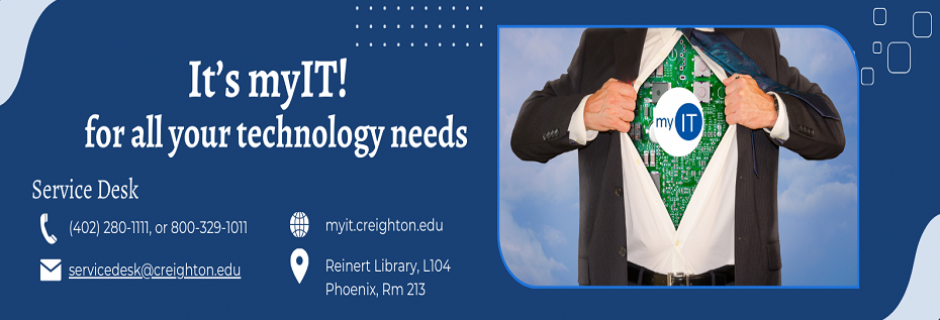


By Phone: Call (402) 280-1111, or 800-329-1011
Online anytime: myServices.creighton.edu
In person at:
| Reinert Memorial Library Lower Level, Room L04 |
Monday-Friday | 8:00 AM to 5:00 PM |
|
Criss Complex III |
Monday-Friday |
By Appointment Only
|
| Dental Building Room 223 |
Monday-Friday |
By Appointment Only |
| Phoenix Room 213 |
Monday-Friday |
9:00 AM to 12:00 PM Arizona Time |
For Self-Help Use Jay Bot: Anytime
Outside normal business hours, calls will be handled by our service partner TierPoint. TierPoint is able to handle most password reset requests and troubleshoot common computer issues. Together the Division of Information Technology and TierPoint provide 24x7 support.












 2500 California Plaza


